
How accurate is Google Gemini for research in 2026 is one of the most important practical questions for students, academics, journalists, and professionals who want to use AI as a research tool they can actually trust.
The short answer: Gemini is among the more accurate AI chatbots available for research — largely because of its real-time Google Search grounding. But it is not infallible, and knowing where it tends to go wrong is just as important as knowing where it excels.
| Overall Research Accuracy Score: 9.0/10
Gemini’s native Google Search integration makes it structurally more accurate for current-events research than most competitors. Primary sources should always be verified for academic work. |
📌 Also in this series: Google Gemini AI Review 2026 · Most Accurate AI Chatbot 2026 · Can Gemini Browse the Web?
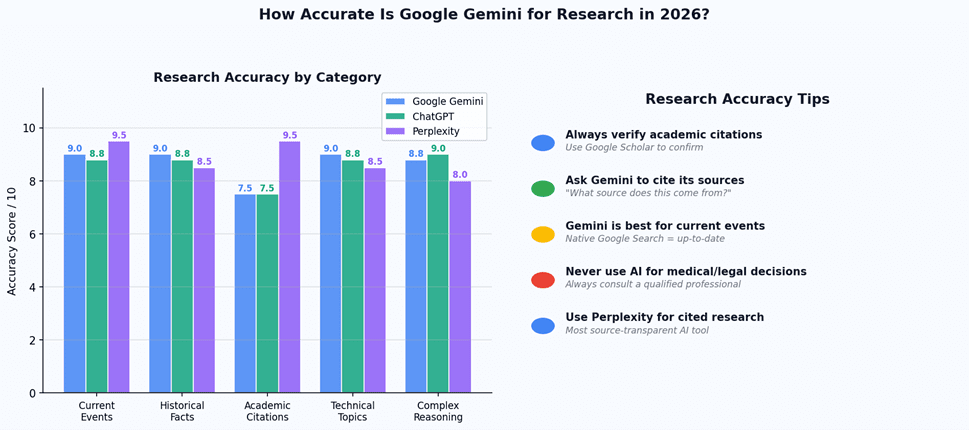
How Accurate Is Google Gemini for Research? — What the Testing Shows
Factual Accuracy for Current Information: Excellent
Gemini’s biggest accuracy advantage is in time-sensitive research. Because it grounds responses in real-time Google Search results by default, it is significantly less likely to give outdated information than models relying purely on training data. For current events, recent publications, current prices, or recent scientific findings — Gemini outperforms ChatGPT and Claude.
This is also why Gemini is one of the strongest performers in our Most Accurate AI Chatbot 2026 comparison.
Factual Accuracy for Historical and Domain-Specific Topics: Very Good
For well-documented historical information and established scientific facts, Gemini performs very well. Its confidence calibration is good — it tends to acknowledge uncertainty when genuinely unsure rather than confidently generating a wrong answer.
Academic Source Citation: Use With Caution
Like all AI chatbots, Gemini can sometimes generate plausible-sounding but incorrect academic citations. Always verify on Google Scholar before using in formal work.
Verify citations at scholar.google.com.
Complex Multi-Step Reasoning: Good
Gemini performs well on research tasks requiring multi-step reasoning — synthesising information from multiple sources, comparing competing theories, and drawing logical conclusions from evidence. Its performance here is competitive with GPT-4o and Claude Sonnet.
Tips for Getting Accurate Research Results From Gemini
- Always ask Gemini to cite its sources — ‘What source does this come from?’ is a useful follow-up
- For academic work, verify every citation in Google Scholar before using it
- Ask ‘How confident are you about this?’ for any claim you plan to act on
- Use Gemini for research direction — use primary sources for final citations
- Never use AI as the sole source for medical, legal, or financial research
Is Gemini More Accurate Than ChatGPT for Research?
For current-events research, yes — Gemini’s native Google Search gives it a structural accuracy advantage. For factual research not requiring current information, both tools perform at a similar level. Perplexity AI leads on citation transparency for academic research.
For the full comparison, see Is Google Gemini better than ChatGPT? and our Best AI Chatbots 2026 guide.
Frequently Asked Questions
Does Google Gemini hallucinate?
Yes — like all AI chatbots, Gemini can produce incorrect information. Its hallucination rate is lower than average for current-events topics thanks to real-time Google Search grounding. Always verify important claims.
Is Google Gemini good for academic research?
Gemini is a useful research assistant for understanding concepts and exploring research directions. It is not reliable as a sole source for academic citations — always verify in primary databases.
Final Answer: Gemini Is Highly Accurate — With Caveats
How accurate is Google Gemini for research in 2026? Very accurate for current-events research — more so than most competitors because of Google Search integration. For academic citation accuracy, treat it as a starting point and verify everything in primary sources.
See our full Google Gemini AI review 2026 for complete test results.