
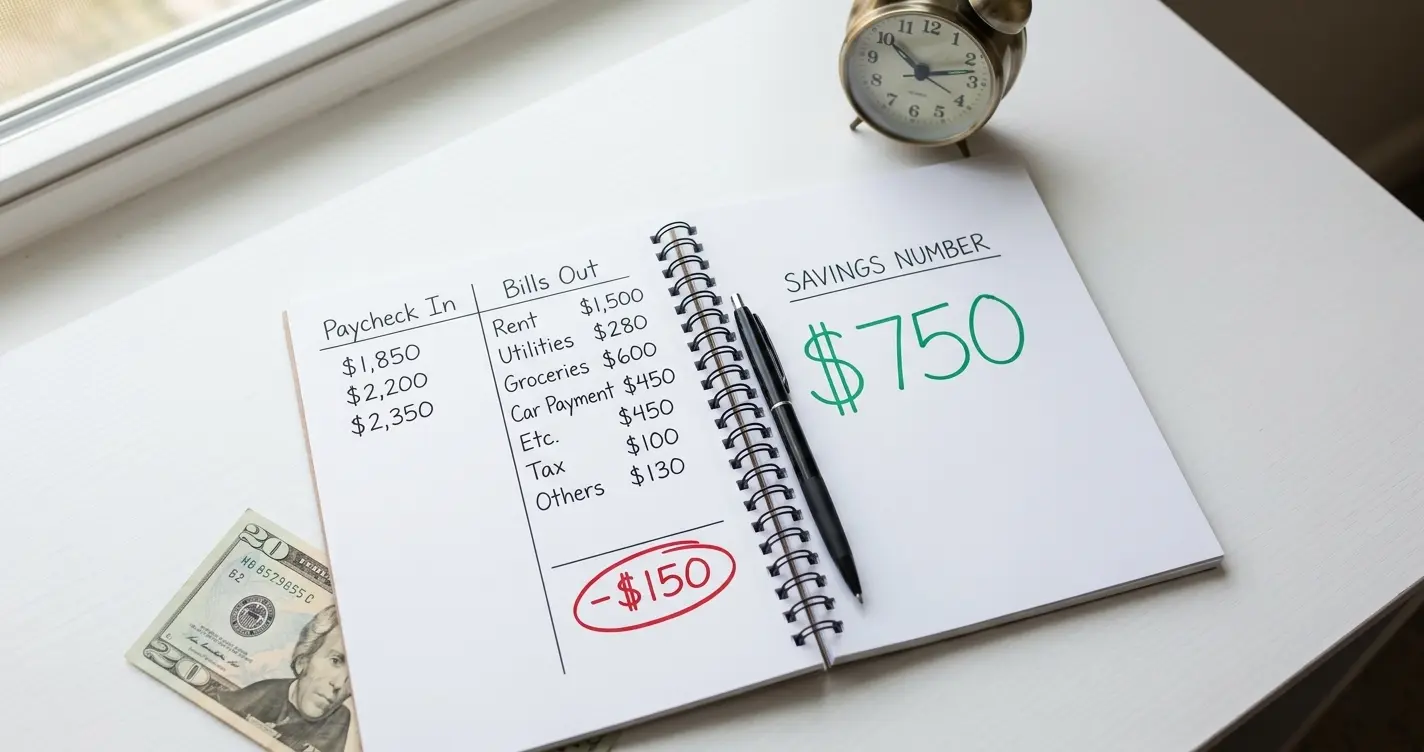
If you’ve ever watched your bank account drain to near-zero a few days before payday and felt that familiar knot of anxiety in your stomach, you’re not alone. According to a 2023 Report on the Economic Well-Being of U.S. Households by the Federal Reserve, roughly 37% of American adults would struggle to cover a $400 emergency expense without borrowing or selling something. Living paycheck to paycheck is one of the most widespread — and emotionally exhausting — financial situations a person can face.
But here’s what those alarming statistics won’t tell you: this cycle is breakable. It doesn’t require a six-figure salary, a lucky investment, or a financial windfall. What it does require is honest self-assessment, a shift in mindset, and a handful of practical strategies applied consistently. This guide walks you through every step — no fluff, no gimmicks, no judgment.
“A budget is telling your money where to go instead of wondering where it went.” — Dave Ramsey
| 💡 Key Takeaway The paycheck-to-paycheck cycle is almost never just about income. It’s a combination of missing buffers, spending on autopilot, and the absence of a deliberate system. All three are fixable — and this guide shows you how. |
1. Understand Why You’re Stuck in the Cycle
Before you can fix a problem, you need to understand what’s actually broken. The paycheck-to-paycheck trap is rarely just about not earning enough — it’s almost always a combination of income constraints, spending patterns, and the complete absence of financial buffers.
The Most Common Culprits
- No budget or spending plan: most people genuinely don’t know where their money goes each month
- Lifestyle inflation: spending rises automatically as income rises, with no intentional savings built in
- High-interest debt consuming a large chunk of monthly take-home pay
- No emergency fund, which forces reliance on credit cards during every unexpected expense
- Low financial literacy: not understanding interest rates, compound growth, or basic investment principles
- Psychological spending triggers: stress shopping, social comparison, impulse buying, and retail therapy
Understanding your personal version of this problem is step one. Write down which of these apply to you. Honesty here is not optional — it’s the entire foundation of everything that follows.
2. Calculate Your Real Monthly Numbers
Most people overestimate how much they earn and dramatically underestimate how much they spend. That gap between perception and reality is precisely where financial stress lives.
Track Every Dollar for 30 Days
Use a free tool like YNAB (You Need A Budget) to track every single transaction for one full month. Do not change your behavior during this period — just observe. You need accurate data, not aspirational data. The results will surprise you. If you want a complete system for this, our guide on how to track your expenses daily walks through the exact habit-building process.
Calculate Your Real Take-Home Income
Your take-home pay — after taxes, health insurance deductions, and any retirement contributions — is your real working budget. Use this number, not your gross salary, for every financial calculation you make going forward.
Map Fixed vs. Variable Expenses
- Fixed expenses: rent or mortgage, loan repayments, insurance premiums, subscriptions — amounts that don’t change month to month
- Variable expenses: groceries, dining out, entertainment, fuel, clothing — amounts you can actively influence
Once you see where every dollar actually goes, you’ll identify several areas where spending is happening on complete autopilot — and those are your first targets for change.
3. Build a Budget That Actually Works
A budget is not a punishment. It’s simply a plan — a way of telling your money where to go instead of wondering where it went. The right method depends on your personality and circumstances.
The 50/30/20 Rule (Best for Beginners)
This straightforward framework, widely referenced by financial advisors and institutions like NerdWallet, divides take-home pay into three categories:
- 50% for Needs — housing, utilities, groceries, transportation, minimum debt payments
- 30% for Wants — dining out, entertainment, hobbies, non-essential subscriptions
- 20% for Savings and Extra Debt Repayment — emergency fund, investments, paying more than minimums
If your needs are currently consuming 70% of income, don’t panic — that’s exactly why you’re in this situation. The goal is to work toward the ideal ratio gradually and deliberately.
Zero-Based Budgeting (Best for Detail-Oriented People)
With zero-based budgeting, every dollar of income gets assigned a specific job — so income minus all assigned spending equals zero. YNAB’s four-rule system is built around this method and is highly effective for people who need full visibility and control over every dollar.
The Cash Envelope Method
For those who consistently overspend with cards, physically using cash creates friction that digital payments don’t. Withdraw cash for each variable spending category; when the envelope is empty, spending in that category stops until next month.
4. Build a Starter Emergency Fund — Immediately
This is the single most important financial move you can make while breaking the paycheck-to-paycheck cycle. Without an emergency fund, every unexpected expense — a car repair, a medical bill, a broken appliance — becomes a financial crisis that can set you back months.
| 🎯 Your First Target Save $1,000 as quickly as possible. This isn’t your final emergency fund — it’s the buffer that stops every financial curveball from requiring a credit card. |
How to Build It Quickly
- Sell items you no longer need — electronics, clothes, furniture on Facebook Marketplace, eBay, and Craigslist. Many people raise $200–$500 in their first weekend.
- Take on a short-term side hustle: food delivery, freelance work, pet sitting, tutoring, or odd jobs through TaskRabbit.
- Temporarily cut all non-essential spending and redirect every spare dollar toward this goal.
- Check your state’s unclaimed property database — many people have unclaimed money they don’t know about.
Once you’ve stabilized, work toward 3–6 months of expenses. The Consumer Financial Protection Bureau (CFPB) offers free, unbiased guidance on building emergency savings. For the complete step-by-step process, see our guide on how to build an emergency fund fast.
5. Attack Your Debt With a Clear Strategy
High-interest debt — especially credit card balances at 20–29% APR — is one of the primary engines keeping people in the paycheck-to-paycheck cycle. Until that interest drain is stopped, building meaningful savings is extremely difficult.
The Debt Avalanche (Mathematically Optimal)
List all debts from highest interest rate to lowest. Make minimum payments on everything, then put every additional dollar toward the highest-rate debt. Once eliminated, roll that payment into the next debt on the list. This method minimizes total interest paid over time.
The Debt Snowball (Psychologically Powerful)
List debts smallest balance to largest. Pay the smallest off first for a fast win, then build momentum from there. Research published by the Harvard Business Review supports the idea that psychological wins from quick victories significantly improve long-term financial follow-through.
Consolidation as a Tool
If you carry multiple high-interest debts, a personal loan or a 0% balance transfer card could reduce your overall interest burden. Use NerdWallet’s debt consolidation calculator to model whether this makes sense for your specific situation.
6. Cut Expenses Without Destroying Your Quality of Life
The goal is never to make yourself miserable — it’s to identify spending that isn’t genuinely making you happier and redirect those dollars toward financial security. There’s a meaningful difference between cutting what you love and cutting what you’ve forgotten you’re even paying for.
High-Impact Cuts Most People Don’t Miss
- Cancel streaming services you use less than twice a week — rotate them seasonally instead of subscribing to all of them simultaneously
- Audit all subscriptions: gym memberships, software tools, meal kit boxes, premium news sites, and app purchases
- Reduce restaurant dining from 5x per week to 2x — meal prep for the rest. This single change often saves $200–$400 per month
- Negotiate recurring bills — insurance, internet, and mobile plans are frequently negotiable, especially when speaking with retention departments
- Switch to store brands for groceries — Consumer Reports consistently finds that generic products match or exceed name-brand quality in blind tests
- Use your local library for books, audiobooks, and even streaming services like Kanopy and Libby
The 24-Hour Purchase Rule
Before buying anything non-essential, wait 24 hours. For purchases over $100, wait 72 hours. You’ll find that a surprisingly large percentage of impulse purchases simply don’t seem necessary once the initial dopamine spike of browsing has passed.
7. Increase Your Income — For Some, It’s Non-Negotiable
For certain people, the paycheck-to-paycheck cycle persists not because of poor spending habits but because income is genuinely insufficient for their cost of living. If you have already cut spending to the bone and still can’t save, the answer is to earn more.
Concrete Ways to Earn More
- Negotiate your salary: use data from Glassdoor, LinkedIn Salary, or the Bureau of Labor Statistics to benchmark your worth and make a data-driven case to your employer
- Upskill strategically: platforms like Coursera and Google Career Certificates offer affordable paths into higher-paying roles in tech, data, and project management
- Start a side hustle: freelancing on Upwork or Fiverr, selling handmade goods on Etsy, tutoring, dog walking, or offering local services
- Gig economy options: food delivery, grocery shopping, or rideshare driving for flexible supplemental income
- Rent out space you own or lease: a spare room, a parking spot, a storage corner, or even your driveway
8. Automate Everything — Remove Willpower from the Equation
One of the most counterproductive aspects of traditional budgeting advice is that it relies entirely on willpower — a finite and highly unreliable resource. Well-designed financial systems work whether you’re motivated or not.
The Core Automation Stack
- Direct deposit splits: if your employer allows it, route a set amount directly to savings before it ever hits your checking account
- Automatic bill payments: set all fixed bills to autopay and eliminate late fees permanently
- Automatic savings transfers: schedule a transfer on payday to a high-yield savings account (HYSA) currently offering 4–5% APY
- Automatic retirement contributions: if your employer matches 401(k) contributions, contribute at least enough to capture the full match — it is quite simply free money
High-yield savings accounts currently offer rates of 4–5% APY, compared to the national average of 0.46% for standard savings accounts. Find current top rates at Bankrate’s HYSA comparison.
9. Shift Your Money Mindset
Financial behavior is deeply psychological. Many of our money habits were formed in childhood, reinforced by our upbringing, and compounded by the consumption culture we’re surrounded by. Lasting financial change requires working on the mindset alongside the math.
Mindset Shifts That Actually Move the Needle
- From shame to agency: financial difficulty is extraordinarily common. Shame keeps people paralyzed; agency creates movement. You didn’t get here overnight, and you won’t get out overnight — but you can get out.
- From keeping up to intentional living: social media creates artificial financial benchmarks that fuel overconsumption. Comparing yourself to others’ highlight reels is an expensive hobby.
- From present-only to future-focused: learning to feel the emotional satisfaction of saving is a trainable skill. Visualize what financial stability actually looks like for you — not what it looks like for someone else.
- From all-or-nothing to consistent progress: missing one budget category doesn’t mean starting over. Progress, not perfection, is the goal.
Two books widely recommended by financial planners: The Psychology of Money by Morgan Housel and I Will Teach You to Be Rich by Ramit Sethi. Both address the behavioral dimension of personal finance in highly practical ways.
10. Your 90-Day Action Plan
Knowing what to do is very different from doing it. Here is a concrete 90-day roadmap to start breaking the cycle today.
| Month | Focus | Key Actions |
| Month 1 | Diagnose & Stabilize | Track every expense for 30 days using Mint or YNAB — no behavior change, just dataCreate your first monthly budget using the 50/30/20 frameworkOpen a separate high-yield savings account for your emergency fundList all debts: creditor name, balance, interest rate, and minimum paymentCancel at least 2–3 subscriptions you actively don’t use |
| Month 2 | Build Momentum | Save your first $500 toward the $1,000 starter emergency fundMake one extra debt payment above your minimum on your highest-rate debtIdentify one concrete income-increase action: apply for a raise, list a freelance service, or pick up extra hoursImplement the 24-hour rule for all discretionary purchases |
| Month 3 | Systematize & Accelerate | Complete the $1,000 starter emergency fundSet up automatic savings transfers and autopay for all fixed billsReview and refine your budget using 60 days of real data — adjust categories that are consistently offBegin planning long-term: 3–6 month emergency fund, retirement contributions, debt payoff timeline |
Frequently Asked Questions
How long does it realistically take to stop living paycheck to paycheck?
For most people, the first meaningful shift — a small emergency fund and a working budget — takes 60–90 days of consistent effort. Breaking the cycle entirely, with 3–6 months of expenses saved and debt under control, typically takes 12–24 months. The timeline depends heavily on income, debt load, and how aggressively you pursue income increases. The most important thing is that every month you follow the system, your position improves.
What if my income is too low to save anything at all?
If you’ve tracked every dollar and genuinely can’t find any margin, income is the constraint — not discipline. In that case, the priority becomes earning more before anything else: a part-time shift, a side hustle, upskilling for a better-paying role, or applying for government assistance programs. Even $25/month into a savings account matters — it builds the habit and the account while you work on the income side.
Should I pay off debt or save an emergency fund first?
Build the $1,000 starter emergency fund first, then shift focus to high-interest debt (20%+ APR). Without that starter cushion, every surprise expense will push you back into debt and erase your progress. Once high-interest debt is gone, build your full 3–6 month emergency fund, then move to lower-interest debt and investing.
Is the paycheck-to-paycheck cycle a willpower problem?
Mostly no. Most people in this cycle are not undisciplined — they’re operating a system with no buffers, no visibility, and no automation. Willpower is unreliable by design. The real solution is building systems that work automatically: automated savings, autopay, a pre-built budget. When the system is right, willpower barely enters the picture.
What’s the single most impactful first step I can take today?
Open a dedicated high-yield savings account at a separate bank and set up an automatic transfer of even $25 per payday. This one action installs the “pay yourself first” principle and starts building the habit. You can optimize the amount later — the critical move is making it automatic and making it today.
Can I invest while still living paycheck to paycheck?
One exception: always contribute enough to your 401(k) to capture your employer’s full match — that’s an instant 50–100% return on your money, which beats any other investment. Beyond that, hold off on broader investing until you have your emergency fund and have dealt with high-interest debt. Once those are in place, investing becomes the logical next step — see our guide on saving vs. investing for how to think about the transition.
How do I handle irregular or seasonal income?
Budget based on your lowest expected monthly income. In months when you earn more, allocate the surplus immediately — to your emergency fund, then debt, then savings goals — before lifestyle inflation has a chance to absorb it. The zero-based budgeting method is especially effective for irregular earners because you build a new budget each month based on actual income, not an estimate.
What are the psychological signs I’m making real progress?
The most reliable signal: you stop feeling anxiety before payday. When a $300 car repair is an annoyance rather than a crisis, you’ve broken the cycle. Other signs include: checking your bank account out of curiosity rather than fear, declining impulse purchases without regret, and feeling genuinely excited to review your budget rather than dreading it.
Recommended Tools and Resources
Budgeting Apps
- YNAB (You Need A Budget) — Best for zero-based budgeting and intentional spending
- Empower (formerly Personal Capital) — Best for combined spending and investment tracking
Financial Education
- Consumer Financial Protection Bureau — Government resource for unbiased financial guidance
- Khan Academy Personal Finance — Free, comprehensive financial literacy courses
Savings and Banking
- Bankrate HYSA Comparison — Find the highest-yielding savings accounts
- MyCreditUnion.gov Locator — Credit unions often offer better rates and lower fees than traditional banks
The Bottom Line
Living paycheck to paycheck is exhausting — but it is not permanent. The path forward isn’t glamorous: it’s a budget you actually follow, a small emergency fund you protect fiercely, and consistent choices made week after week over months and years.
The people who break this cycle aren’t smarter or luckier than you. They made a decision, built a system, and stuck with it long enough for the results to compound. Start today. Not Monday. Not after the next paycheck. Pick one thing from this guide and act on it within the next 30 minutes: open a savings account, download a budgeting app, cancel one subscription. The cycle breaks one small action at a time — and that first action is the most important one you’ll ever take.
Financial freedom is not about having a perfect plan. It’s about starting an imperfect one — and refining it as you go.
| 🚀 Your 3-Step Action Plan 1. Download YNAB or open a free tracking app and log every expense for the next 30 days — no changes, just observation. 2. Open a separate high-yield savings account today and set up an automatic $25–$50 transfer for payday. 3. List every debt you have: name, balance, interest rate, minimum payment. Then choose — avalanche or snowball — and make one extra payment this month. |