
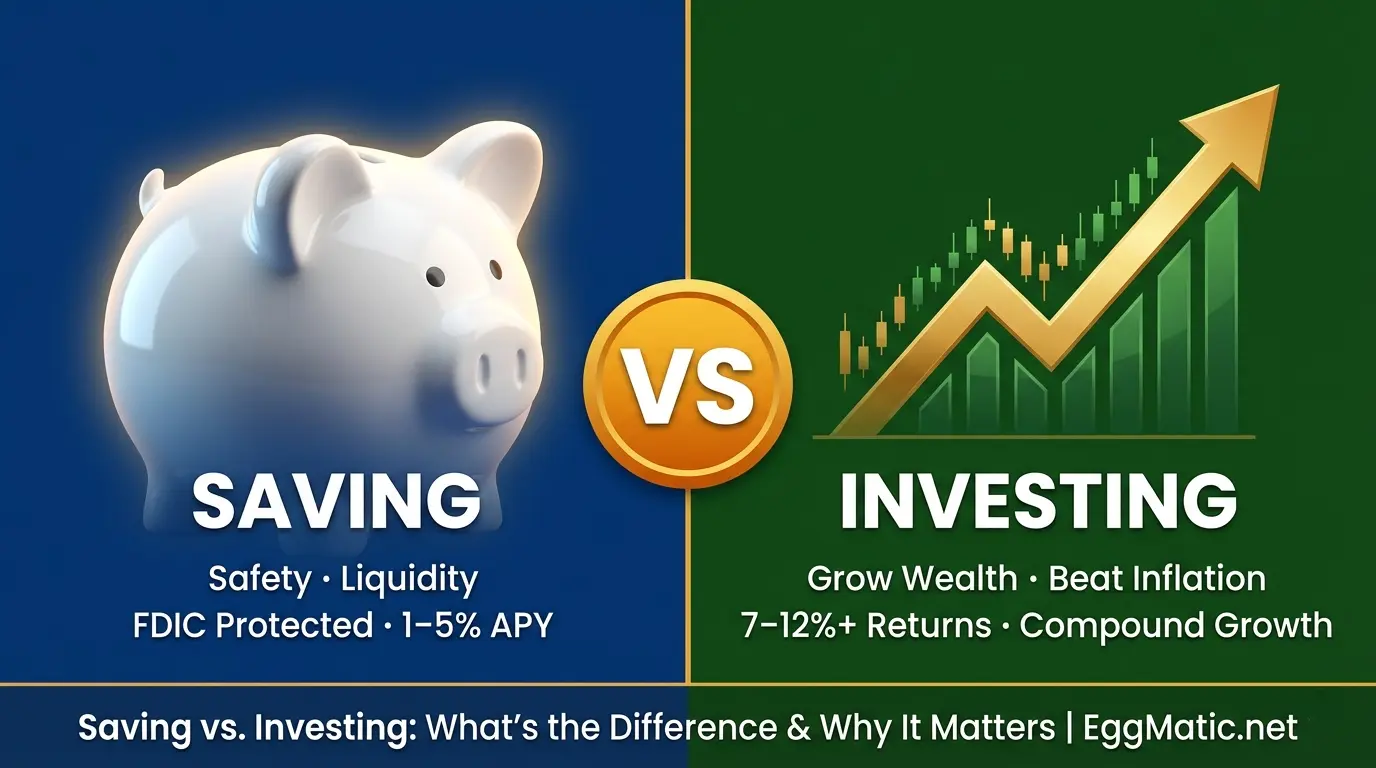
Here’s the truth most people don’t want to hear: most Americans are quietly losing wealth every single month — not because they’re careless, but because nobody ever clearly explained the difference between saving vs investing. If you’ve been tossing everything into a savings account and calling it a financial plan, this guide is going to change the way you think about money.
Saving and investing are not the same thing. They serve different purposes, carry different levels of risk, and produce very different results over time. Mixing them up — or worse, skipping one entirely — can cost you tens of thousands of dollars over your lifetime without you even realizing it.
In this guide you’ll get a clear, plain-English breakdown of saving vs investing: what each means, when to use which, how much to put where, and the most common mistakes Americans make when they confuse the two.
| 💡 Key Takeaway Saving protects your money. Investing grows your money. The financially smart move is knowing exactly when to do each — and this guide will show you how. |
What Is Saving? Your Financial Safety Net
Saving is the act of setting aside money in a safe, liquid account — typically a high-yield savings account, money market account, or certificate of deposit (CD). The sole purpose of saving is preservation: you want your money to be right there, untouched and accessible, when you need it.
Think of your savings as your financial shock absorber. When your car breaks down, your water heater fails, or you unexpectedly lose your job, your savings fund keeps you from going into debt or derailing your long-term plans.
Common Savings Vehicles in the U.S.
- High-Yield Savings Accounts (HYSAs) — Online banks currently offering 4.5–5.25% APY
- Money Market Accounts (MMAs) — Slightly higher rates with limited check-writing
- Certificates of Deposit (CDs) — Fixed rates for a set term (3 months to 5 years)
- Treasury Bills — Short-term U.S. government securities, extremely safe
The FDIC insures savings accounts at member banks up to $250,000 per depositor — making them one of the safest places to keep your cash in the U.S.
| ⚠️ When Saving Makes Sense Use savings for any goal within 1–3 years, or to build an emergency fund covering 3–6 months of living expenses. Not sure where to start? Read our step-by-step guide: How to Build an Emergency Fund Fast. |
What Is Investing? Putting Your Money to Work
Investing is deploying your money into assets — stocks, bonds, ETFs, index funds, real estate — with the expectation of earning a return over time. Unlike saving, investing carries risk: your investment’s value can fall. But here’s the counterintuitive truth most people miss:
Over the long run, NOT investing is often riskier than investing. Why? Because of inflation. If your savings account earns 2% annually and inflation runs at 3%, you are quietly losing purchasing power every single year.
Historically, the S&P 500 has returned an average of approximately 10% per year before inflation, or around 7% after adjusting for it. According to Investor.gov (the U.S. SEC’s official investor education portal), a $10,000 investment in 1990 would be worth over $180,000 today — with dividends reinvested.
| I started investing $100/month into a Roth IRA at 24. By the time I ran this site’s first analysis, that account had grown to nearly $18,000 — without me touching it once. The compounding is real. The hardest part is just starting. |
Common Investment Vehicles for Americans
- Stocks — Individual company equities
- Exchange-Traded Funds (ETFs) and Index Funds — the simplest, lowest-cost way to diversify
- Bonds and Fixed-Income Securities
- Real Estate Investment Trusts (REITs) — real estate exposure without buying property
- Retirement Accounts: 401(k), Traditional IRA, Roth IRA
For the full breakdown of investment types and risk profiles, see the U.S. SEC Investor.gov guide. And before you invest, make sure you’re not stuck in the paycheck cycle: How to Stop Living Paycheck to Paycheck
Saving vs. Investing: Side-by-Side Comparison
Before diving into the five key differences, here’s your quick-reference comparison:
| Feature | Saving | Investing |
| Purpose | Short-term goals & emergencies | Long-term wealth growth |
| Risk Level | Very low — none | Low to high |
| Returns | 1–5% annually (interest) | 7–12%+ historically |
| Liquidity | High — access anytime | Low to medium |
| Time Horizon | Days to 3 years | 3+ years (ideally 10+) |
| Common Accounts | Savings, CDs, money market | Stocks, ETFs, real estate, 401(k) |
| Best For | Emergency fund, near-term goals | Retirement, wealth building |
| Inflation Risk | May lose purchasing power | Typically outpaces inflation |
| Effort Required | Minimal — set and forget | Periodic check-in recommended |
The 5 Core Differences Between Saving and Investing
1. Risk and Safety
Savings in an FDIC-insured account carry virtually zero risk — your principal is guaranteed up to $250,000. Investments can and do lose value. A stock portfolio can drop 30–50% in a market downturn, as millions of Americans experienced in 2008 and in March 2020.
That said, investment risk is largely a function of time. Historically, no 20-year period in the S&P 500 has ever ended with a net loss for investors who stayed fully invested. The longer your horizon, the lower your practical risk.
2. Returns and Growth Potential
Savings accounts pay 0.01% to 5.25% APY today. Investing in a diversified portfolio has historically returned 7–10% annually. The math is striking: investing $500 per month for 30 years at 7% produces over $566,000 — more than triple what you’d accumulate in a savings account.
3. Liquidity
Savings accounts are highly liquid — withdraw funds the same day in most cases. CDs are the exception: breaking them early triggers a penalty of 60–180 days of interest.
Most investments are also liquid, but selling at the wrong time means locking in losses. Retirement accounts add a harder layer: 401(k) withdrawals before age 59½ trigger a 10% penalty plus income taxes.
4. Time Horizon
Your goal’s timeline is the single most important factor when choosing between saving and investing:
- Save for goals within 1–3 years — vacation, car, emergency fund, near-term down payment
- Invest for goals 5+ years away — retirement, college tuition, long-term wealth building
5. Inflation Protection
Inflation is the silent killer of savings. The U.S. Bureau of Labor Statistics CPI has tracked inflation at 3–9% in recent years. If your savings account earns 2%, you are losing purchasing power in real terms every year you leave money there.
Equities and real estate have historically served as effective inflation hedges. As prices rise, companies raise their prices too — which flows into earnings and stock values. That’s why a diversified portfolio is your best long-term defense against inflation.
How Much Should You Save vs. Invest?
There’s no single right answer, but one framework has stood the test of time: the 50/30/20 rule.
- 50% of your after-tax income → Needs (rent, food, utilities, insurance, transportation)
- 30% → Wants (dining out, entertainment, subscriptions, travel)
- 20% → Savings and investments combined
Within that 20%, follow this priority order:
- Step 1: Build a $1,000 starter emergency fund — your cushion against small shocks
- Step 2: Contribute enough to your 401(k) to get the full employer match — this is free money
- Step 3: Aggressively pay off high-interest debt (credit cards, payday loans)
- Step 4: Build your emergency fund to 3–6 months of living expenses
- Step 5: Max out tax-advantaged accounts: Roth IRA ($7,000/yr), 401(k) ($23,500/yr in 2026)
- Step 6: Invest additional surplus in taxable brokerage accounts
| 💰 IRS Limits 2026 Roth IRA: $7,000/yr ($8,000 if 50+) · 401(k): $23,500/yr ($31,000 if 50+) · HSA: $4,300 individual / $8,550 family. See official rules at IRS.gov/retirement-plans. |
Need a proven system for allocating every dollar? Read: Zero-Based Budgeting for Beginners: The Complete 2026 Guide
5 Common Mistakes Americans Make With Saving and Investing
Mistake #1: Keeping Too Much Cash in a Savings Account
Once your emergency fund is fully funded, leaving large sums in a 0.5% savings account while inflation runs at 3% is a wealth-erosion strategy. Every month, your money quietly loses buying power. Deploy the surplus into investments — especially tax-advantaged retirement accounts.
Mistake #2: Investing Your Emergency Fund
The opposite mistake is just as costly. Your emergency fund must be liquid and protected. If you invest it and the market drops 30% right when you lose your job, you’d be forced to sell at a loss — turning a temporary setback into a lasting financial wound.
| I made this exact mistake in 2022. I had my ’emergency fund’ in ETFs instead of a HYSA. The market dropped 20% in Q1. I had to sell at a loss to cover an unexpected car repair. It set me back almost $3,000 in real terms. Never again. |
Mistake #3: Waiting for the ‘Perfect Time’ to Invest
Market timing is one of the most consistently failed strategies in personal finance. Research by Charles Schwab found that missing just the 10 best trading days over a 20-year period can cut your total returns by more than half. The best time to invest was yesterday. The second-best time is today.
Mistake #4: Skipping Tax-Advantaged Accounts
Millions of Americans invest in taxable brokerage accounts before maxing out their 401(k) or IRA — leaving enormous tax savings on the table. A Roth IRA lets your investments grow 100% tax-free for the rest of your life. See official rules at the IRS Retirement Plans page.
Mistake #5: Not Automating Your Contributions
Behavioral finance research consistently shows that people who automate their contributions build more wealth than those who transfer manually. Set your transfers to happen the day after payday. Automation removes willpower from the equation entirely.
Still struggling with monthly cash flow? Start here: How to Track Your Expenses Daily
Saving vs. Investing by Life Stage
Your saving vs investing balance should shift as your age, income, and financial goals evolve.
Young Adults (Ages 22–35): Time Is Your Greatest Asset
At this stage you have the most powerful financial tool available: time. Investing just $200 per month from age 22 at a 7% annual return produces over $525,000 by age 65. Build a 3-month emergency fund first, then invest as aggressively as your risk tolerance allows. Start your Roth IRA as soon as possible — the tax-free compounding is irreplaceable.
Mid-Career (Ages 35–50): Balance Both Aggressively
By now you should have a fully funded emergency fund and be maximizing retirement contributions. Use a dual-track strategy: save for near-term goals within 5 years, and invest for longer-term ones. This is also the decade to eliminate all high-interest consumer debt entirely.
Pre-Retirement (Ages 50–65): Gradually De-Risk
Gradual de-risking makes sense here. Shift a portion of your portfolio from equities toward bonds and stable assets. Build a 12-month cash cushion to avoid being forced to sell investments during a market downturn right when you need cash the most. Take advantage of 401(k) catch-up contributions: an extra $7,500/year for those 50+.
The Bottom Line: You Need Both — and Here’s How to Start
Saving and investing aren’t competing strategies — they’re complements. Saving gives you the stability to survive setbacks without blowing up your financial future. Investing gives your money the compounding power to outgrow inflation and build lasting wealth.
The most financially secure Americans aren’t those who save the most in isolation, or invest the most recklessly. They’re the ones who understand when to save and when to invest — and they follow a system, not their emotions.
Start where you are. Even $50 a month into a Roth IRA is better than waiting. Even a $500 emergency fund is better than nothing. The perfect financial plan you never execute is worth nothing compared to an imperfect one you start today.
| 🚀 Your 3-Step Action Plan 1. Open a high-yield savings account and automate contributions toward your emergency fund. 2. Enroll in your employer’s 401(k) and contribute at least enough to get the full employer match. 3. Open a Roth IRA at Vanguard, Fidelity, or Schwab and set up automatic monthly contributions. |