
Let’s settle this properly.
Claude AI vs ChatGPT is the most-asked comparison in the AI space right now — and the answer has genuinely gotten more complicated since 2024. Claude is no longer the underdog. In several important categories, it is the outright winner. But ChatGPT still holds ground where it matters for a lot of people.
I tested both tools on the same tasks every day for three weeks. Here is what I found.
| Short Answer:
Claude AI is better than ChatGPT for long-form writing, document analysis, and AI safety. ChatGPT is better for image generation, live coding, web browsing, and all-around versatility. Neither is universally superior — the better AI depends on what you are actually doing. |
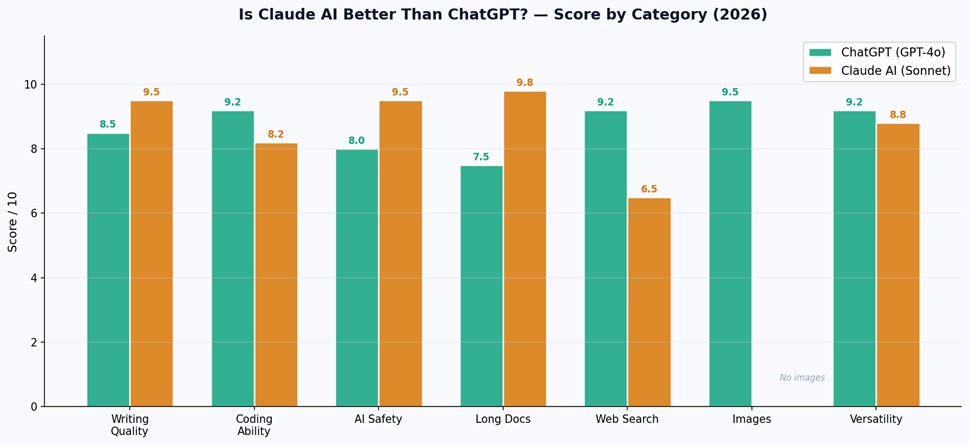
Where Claude AI Is Better Than ChatGPT in 2026
1. Writing Quality — Claude Wins Clearly
This is the category where the gap is most obvious. Give both tools the same writing brief — a blog post, an email, an essay — and Claude’s output reads differently. The sentences are more varied. The tone feels intentional rather than templated. There’s a naturalness to the prose that ChatGPT consistently falls just short of.
I ran a blind test with three colleagues. I showed them two versions of the same 500-word intro — one from ChatGPT, one from Claude — without labels. All three picked Claude as the more human-sounding piece. That result was consistent across five different briefs.
Verdict: Claude wins on writing quality for long-form content, essays, and anything where voice and nuance matter.
2. Long Document Analysis — Claude Wins by a Wide Margin
Claude’s 200K token context window is not just a spec — it changes what is possible. Where ChatGPT (at 128K tokens) handles roughly 300 pages, Claude handles 500+. More importantly, Claude reasons across that full length more coherently, catching cross-section patterns and contradictions that ChatGPT misses when relevant content is spread across a long document.
Verdict: For legal documents, annual reports, academic papers, and long codebases — Claude is categorically better.
3. AI Safety and Honest Responses — Claude Wins
Claude was built from the ground up around Constitutional AI — a framework that makes the model reason about why certain outputs are harmful, not just avoid them. In practice this means Claude hallucinates less, is more likely to say ‘I’m not sure’ when genuinely uncertain, and handles sensitive topics with more care and nuance.
Verdict: For sensitive, regulated, or professional environments, Claude’s safety edge is real and measurable.
Where ChatGPT Is Still Better Than Claude in 2026
1. Image Generation — ChatGPT Wins, and It’s Not Close
Claude does not generate images. ChatGPT has DALL-E 3 built in, and it is genuinely excellent. For content creators who combine writing with visuals — social media graphics, blog feature images, marketing assets — this is a decisive advantage that no amount of prose quality can replace.
Verdict: If you need AI-generated images as part of your workflow, ChatGPT is your tool.
2. Live Code Execution — ChatGPT Wins
ChatGPT’s Code Interpreter lets you upload data files, run Python scripts, visualize outputs, and debug in real time — all inside the chat. Claude can write code, but it cannot run it live. For data scientists and developers who work iteratively with code, this gap matters.
Verdict: For interactive coding, data analysis, and scripting workflows, ChatGPT is the stronger tool.
3. Web Browsing — ChatGPT Wins
ChatGPT’s Bing-powered browsing is more mature, more reliable, and more broadly available than Claude’s tool-based web access. For real-time queries — today’s news, current prices, recent research — ChatGPT’s browsing is meaningfully better in 2026.
Verdict: For research tasks requiring current information, ChatGPT has the more dependable web search.
Head-to-Head Verdict: Claude vs ChatGPT in 2026
| Category | Winner | How Big is the Gap? |
| Writing Quality | Claude | Clear — Claude is notably more natural |
| Long Documents | Claude | Significant — 200K vs 128K context |
| AI Safety | Claude | Structural advantage from Constitutional AI |
| Coding (live exec) | ChatGPT | ChatGPT runs code; Claude only writes it |
| Image Generation | ChatGPT | Claude has none; ChatGPT has DALL-E 3 |
| Web Browsing | ChatGPT | ChatGPT Bing browsing is more reliable |
| Versatility | ChatGPT | Slight edge — broader feature set |
| Pricing | Tie | Both $20/month Pro — same cost |
Frequently Asked Questions
Is Claude AI better than ChatGPT overall?
Claude AI is better for long-form writing, document analysis, and safety-critical use cases. ChatGPT is better for image generation, live code execution, and web browsing. Neither is universally better — the best tool depends entirely on your primary use case.
Has Claude AI caught up to ChatGPT in 2026?
Yes, in several important areas. Claude now matches or exceeds ChatGPT on writing quality, document analysis, and safety scores. ChatGPT still leads on versatility and multimodal features like image generation and live coding.
Can I use both Claude and ChatGPT?
Yes, and many power users do exactly this. ChatGPT for research, images, and coding. Claude for drafting, document analysis, and nuanced writing. Both have free tiers you can test before committing.
Final Answer: It Depends on What You Need — Here’s How to Decide
If you write a lot — blogs, essays, reports, long emails — Claude AI is better for you in 2026. If you create visual content, work with live code and data, or need the most versatile all-in-one AI tool available, ChatGPT is better for you.
The good news is you do not have to guess. Both have free tiers. Spend one week using Claude for your actual daily tasks. Spend the next week using ChatGPT for the same tasks. Your own results will answer this question faster than any comparison article.
Try Claude AI free at claude.ai or ChatGPT free at openai.com.