
This is one of the most practical questions people ask about Claude — and the answer has a ‘yes, but’ attached to it.
Claude AI does have web access in 2026. But if you are expecting the same experience as ChatGPT’s Bing-powered browsing, you will find Claude’s web capabilities noticeably more limited. Here is exactly what is going on.
| Short Answer:
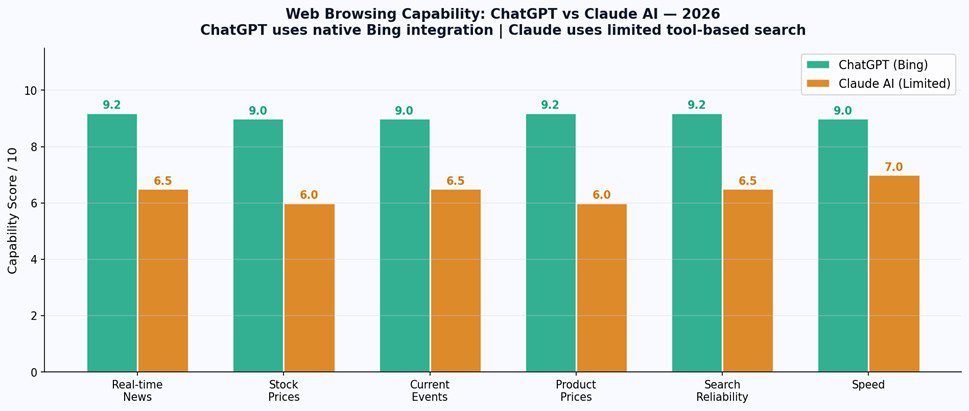
Claude AI can access the web in 2026, but its browsing is less reliable, less broadly available, and less integrated than ChatGPT’s native Bing-powered search. For tasks that depend heavily on real-time web data, ChatGPT is the stronger choice. Claude’s real advantage lies elsewhere. |
How ChatGPT Browses the Web
ChatGPT uses a native Bing integration that was built directly into the model’s toolset. When you ask ChatGPT a question that requires current information, it automatically triggers a web search, retrieves relevant results, and synthesizes them into its answer — often with inline citations.
This works consistently and reliably across a wide range of real-time queries:
- Today’s news and breaking events
- Current stock prices and financial data
- Recent product releases and pricing
- Live sports scores and results
- Current weather and location-specific data
- Recent academic publications and research
The browsing is fast, well-integrated, and available to all ChatGPT users — free and paid. It triggers automatically when relevant, or you can explicitly ask ChatGPT to search the web before answering.
How Claude AI Accesses the Web
Claude’s web access in 2026 works through tool-based integrations — a different architecture from ChatGPT’s native Bing connection. When web search tools are enabled (which depends on the context and platform you are using Claude through), Claude can run search queries and retrieve results.
However, the experience is meaningfully different from ChatGPT’s:
Less automatic: Claude does not always proactively search the web when a question would benefit from current information. You sometimes need to explicitly prompt it to search.
Less consistent: Web access availability can vary depending on which Claude interface or API integration you are using. It is not as uniformly available as ChatGPT’s browsing.
Less real-time: For true real-time data like live stock prices or breaking news, Claude’s tool-based search is less reliable than ChatGPT’s Bing integration.
Side-by-Side: ChatGPT vs Claude for Web Tasks
| Task | ChatGPT | Claude AI | Winner |
| Today’s news | Excellent | Limited | ChatGPT |
| Current stock prices | Excellent | Inconsistent | ChatGPT |
| Recent product pricing | Very Good | Limited | ChatGPT |
| Research paper search | Good | Moderate | ChatGPT |
| Fact-checking claims | Good | Moderate | ChatGPT |
| Current events background | Very Good | Moderate | ChatGPT |
| Deep analysis of web info | Good | Good (if found) | Tie |
What Claude Does Better Instead
While ChatGPT wins on web browsing, it is worth remembering that web access is one specific capability in a much broader tool. Claude’s advantages lie in the areas that do not require live web data:
- Analyzing documents and data you provide directly — Claude’s 200K context is transformative here
- Long-form writing quality — Claude produces more natural, less formulaic prose
- Reasoning across complex, nuanced topics using its training knowledge
- Safety-sensitive professional work — Constitutional AI makes it more reliable for regulated industries
For many professionals, real-time web access is less important than the ability to reason deeply about information they already have. If that describes your workflow, Claude’s web limitation may not matter much in practice.
Frequently Asked Questions
Can Claude AI search the internet in 2026?
Yes, but with limitations. Claude has tool-based web access that is less reliable, less automatic, and less broadly available than ChatGPT’s native Bing-powered browsing. For tasks requiring consistent real-time web data, ChatGPT is the more dependable choice.
Why does Claude not have better web browsing?
Claude’s design priorities focus on reasoning quality, safety, and long-context analysis rather than real-time web connectivity. Anthropic has been more cautious about integrating live web access than OpenAI, prioritizing the accuracy and safety of responses over breadth of data access. This may change as Claude develops further.
Which AI is better for real-time research?
For real-time research requiring current web data, ChatGPT and Perplexity AI are both better than Claude. Perplexity is the gold standard for cited real-time research. ChatGPT’s Bing browsing is strong for general current information. Claude is better for deep analysis of research you already have.
Final Answer: ChatGPT Wins on Web Browsing — But That May Not Matter for You
The honest answer is that ChatGPT is better at browsing the internet than Claude in 2026. If real-time web access is a core part of your daily AI workflow, this is a genuine reason to prefer ChatGPT.
But if you are choosing between them primarily because you want a better writing partner, a document analysis tool, or a safer AI for professional work — Claude’s web limitation is unlikely to be a dealbreaker. Know what you actually need from your AI, and let that guide the choice rather than any single feature comparison.