
Ask a computer science student which AI they use and the answer is almost always ChatGPT. Ask a law student or a literature major the same question and you increasingly hear Claude.
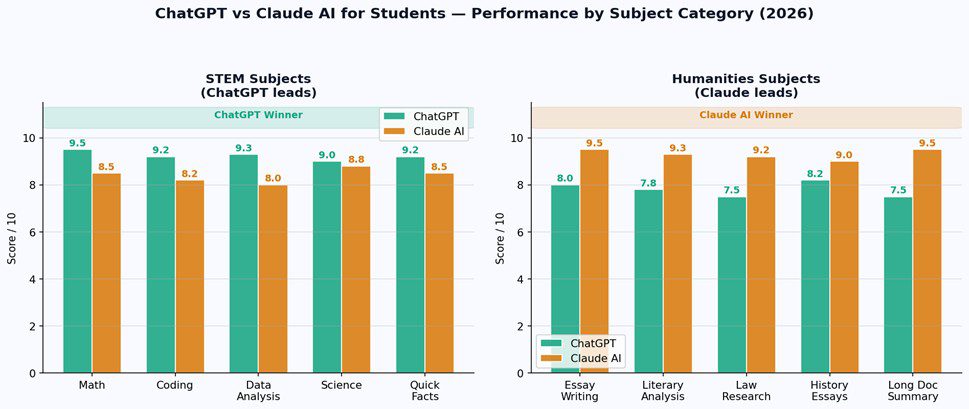
That pattern is not random. It reflects real, consistent differences in how these two AI chatbots perform across different types of academic work. Here is the full breakdown — subject by subject, use case by use case.
| Quick Guide:
ChatGPT for STEM, maths, coding, and quick factual lookups. Claude for essays, literary analysis, legal research, and anything requiring nuanced, thoughtful writing. Both are free to start — try both against your actual coursework before committing. |
ChatGPT for Students: Where It Wins
Mathematics and Statistics
ChatGPT is the strongest AI tool for mathematics at every level. It walks through problems step by step, explains the reasoning behind each stage, handles symbolic algebra and calculus reliably, and can visualize mathematical concepts when paired with its code execution capability. For students struggling with a problem set or trying to understand where their working went wrong, ChatGPT’s mathematical explanation quality is genuinely excellent.
Best use: Work through problems interactively — paste your attempted solution and ask ChatGPT where the mistake is and why.
Coding and Computer Science
For CS students, ChatGPT’s live code execution is a major differentiator. You can write code, run it, debug it in real time, and see the output — all in the chat. This interactive debugging loop is uniquely valuable for learning to code because it closes the feedback cycle immediately. Claude can write and review code, but cannot execute it live.
Best use: Debugging assignments, understanding why your code fails, and learning data structures through interactive examples.
Science Subjects and Quick Factual Research
For biology, chemistry, physics, and general science coursework, ChatGPT’s web browsing gives it an edge for keeping up with recent research and current scientific understanding. Its ability to pull in current sources while explaining concepts makes it more useful for lab reports and literature reviews that require current citations.
Best use: ‘Explain this concept to me, then find me three recent sources I can cite in my lab report.’
Claude AI for Students: Where It Wins
Essay Writing and Argumentation
This is where Claude consistently earns the loyalty of humanities students. Its long-form writing output is more natural, more varied in sentence structure, and better at maintaining argumentative coherence across a multi-page essay. Where ChatGPT essays can feel assembled from parts, Claude essays feel thought through.
More importantly, Claude is better at helping you develop your own argument rather than just generating one. Ask it to challenge your thesis, find weaknesses in your reasoning, or argue the opposing position — and it does so with genuine intellectual depth.
Best use: ‘Here is my thesis and my three main points. What are the strongest counterarguments I need to address?’
Literary Analysis and Close Reading
For students studying literature, poetry, drama, or any text-based discipline, Claude is the stronger tool. Its ability to engage with ambiguity, discuss multiple interpretations, and reason about subtext and context is noticeably better than ChatGPT’s. Claude is willing to sit with complexity rather than rushing to a clean answer.
Best use: ‘Analyze the use of imagery in this poem and explain how it contributes to the central theme — give me at least two different critical readings.’
Law and Social Sciences
Law students repeatedly cite Claude as the more useful AI for their coursework. Its ability to reason across multiple legal principles simultaneously, maintain genuine balance between competing arguments, and handle the nuanced edge cases that make legal analysis interesting — all of this is better in Claude than ChatGPT.
For social science students writing research papers, Claude’s 200K context window is also practically valuable: you can paste an entire set of interview transcripts, field notes, or academic papers and ask Claude to synthesize themes across all of them in one session.
Best use: ‘Here are four academic articles on this topic. What are the main points of disagreement between them and which argument has the strongest evidential support?’
Long Academic Reading and Summarization
For any student who spends time wading through dense academic papers, Claude’s 200K context window is transformative. Paste the entire paper — not just an excerpt — and ask Claude to explain the methodology, summarize the findings, and flag any limitations the authors acknowledge. Then ask follow-up questions about specific sections. It holds the full paper in memory throughout.
Which AI Should You Use for Studying?
| Your Subject | Best AI | Key Reason |
| Mathematics | ChatGPT | Step-by-step problem solving, formula explanation |
| Coding / CS | ChatGPT | Live code execution and interactive debugging |
| Data Science | ChatGPT | Code Interpreter for data visualization |
| Physics / Chemistry | ChatGPT | Strong quantitative reasoning + web research |
| Essay Writing | Claude AI | More natural, coherent long-form output |
| Literature / English | Claude AI | Better at nuance, interpretation, ambiguity |
| Law School | Claude AI | Stronger multi-principle legal reasoning |
| History / Philosophy | Claude AI | Better at balanced, evidence-based argumentation |
| Long Academic Papers | Claude AI | 200K context reads full papers in one session |
| General Research | Perplexity | Cited sources for fact-checking and referencing |
| Important Academic Note:
Using AI to write your assignments and submitting that work as your own is academic dishonesty and violates most universities’ academic integrity policies. Use AI as a study tool — to understand concepts, develop arguments, identify weaknesses in your own reasoning, and learn. Not as a ghostwriter. |
Frequently Asked Questions
Is ChatGPT or Claude better for college essays?
For college application essays and creative personal statements, Claude AI generally produces more authentic, nuanced writing. For academic analytical essays and research papers in STEM, ChatGPT’s structured approach works well. For humanities and social science essays where voice and argument quality matter most, Claude is the stronger choice.
Is it cheating to use AI for studying?
Using AI to understand concepts, check your reasoning, get feedback on your drafts, or prepare for exams is generally considered acceptable — similar to using a tutor. Submitting AI-generated work as your own without disclosure is academic dishonesty. Always check your institution’s specific AI policy.
Which AI is free for students?
Both ChatGPT and Claude offer free tiers that are genuinely useful for students. ChatGPT free gives you GPT-4o with daily limits and some web browsing. Claude free gives you Claude Sonnet with daily limits and the full 200K context window. Perplexity also has a generous free tier for research.
Final Thoughts: Use Both — They Are Free to Try
The most honest advice for students is this: use both. Both ChatGPT and Claude have free tiers. There is no reason to commit to one and never touch the other.
Use ChatGPT when you are doing maths, debugging code, looking up current information, or need a quick structured explanation. Switch to Claude when you are writing an essay, working through a complex argument, analyzing a text, or trying to understand why a long academic paper argues what it argues.
Your subject mix will naturally tell you which one you reach for more often. That is when you will know if upgrading either to a paid plan is worth it.
Start free at claude.ai and openai.com/chatgpt — no credit card needed for either.