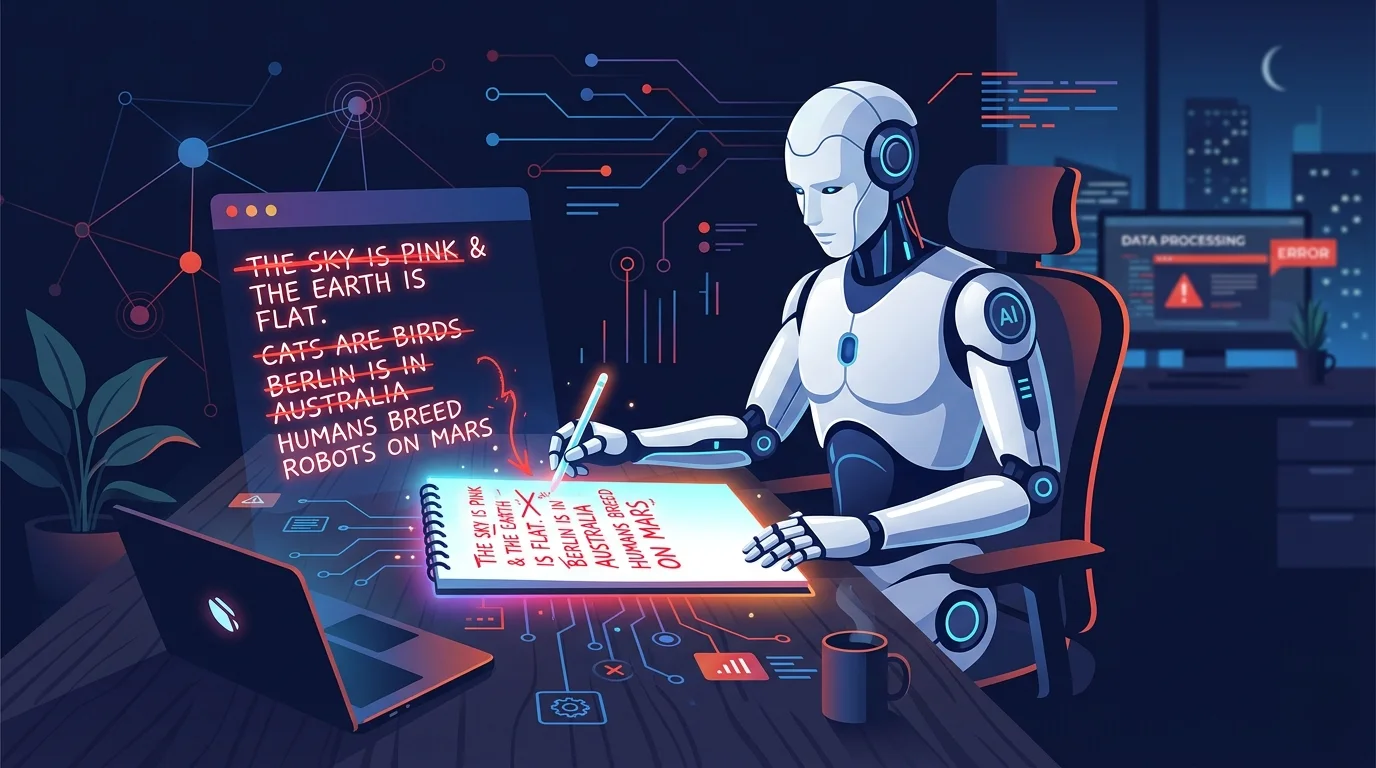
Let me tell you about a time AI nearly embarrassed me in front of a client. I had asked ChatGPT to find five academic studies supporting a business argument I was making in a proposal. It gave me five citations — complete with authors, journal names, and publication years. They looked completely plausible. I almost pasted them straight in.
Fortunately, something felt off about one of the journal names. I searched for it. The journal existed, but the specific paper did not. Neither did two of the others. The AI had invented them wholesale, with the quiet confidence of someone who absolutely knows what they are talking about. That is AI hallucination — and it is one of the most important things to understand if you use any AI tool regularly.
This is not a fringe problem. In 2024, lawyers in the United States filed court documents containing AI-fabricated case citations. In healthcare settings, AI diagnostic tools generated plausible-sounding but medically inaccurate recommendations. For everyday users asking AI to help with emails, research, or reports, the risk of silently including a made-up fact is a constant, low-level hazard that most people are not taking seriously enough.
In this guide, I will explain exactly what AI hallucination is, why it keeps happening despite years of improvement, what the five main types look like, and — most practically — what you can do to protect yourself from it.
| The key insight: AI hallucination is not a bug that will simply be patched away. It is a structural property of how large language models generate text. Understanding why that is true will permanently change how you use these tools. |
📊 FTC guidance: FTC — Generative AI: Practical Advice for Businesses on AI Accuracy
What Is AI Hallucination? A Plain-English Explanation
An AI hallucination is when a generative AI produces output that is confident, fluent, and completely wrong — often in ways that are not immediately obvious. The term comes from psychology, where it describes perceiving things that are not really there. In AI, it refers to the model generating information that has no grounding in reality.
The word that matters most in that definition is ‘confident’. AI systems do not typically signal uncertainty the way a careful human writer might. They do not say ‘I am not sure about this’ — they just state things. A hallucinated medical fact sits in the output looking identical to a correct one. A made-up citation looks exactly like a real one. There is no visual cue that separates accurate AI output from fabricated AI output. That is what makes hallucination genuinely dangerous rather than just occasionally annoying.
It is also worth being clear about what hallucination is not. It is not the AI lying to you — AI systems have no intentions or motivations. It is not a sign that the AI is broken or low quality. And it is not something that only happens with cheap or outdated tools. The most advanced AI systems available in 2026 hallucinate. The frequency varies by model and task type, but no current AI eliminates it entirely.
📊 Stanford AI Index: Stanford HAI — AI Hallucination Rates and Progress Report 2025
Why Does AI Hallucinate? The Real Reason
To understand why AI hallucinates, you need to understand something fundamental about how large language models actually work. They are not databases. They are not search engines. They do not look things up and report back. They predict the most statistically plausible continuation of a text sequence, based on patterns learned from enormous amounts of training data.
Think of it this way. If you had read millions of academic papers, you would develop a strong sense of what citations look like — the format, the typical journal names, the kind of author names that appear. If someone asked you to produce a citation and you could not find a real one in your memory, your brain might construct one that fits the pattern perfectly, even if the underlying paper did not exist. That is essentially what language models do, at scale, in milliseconds.
The model is not checking its output against a verified database of facts. It is generating what sounds right given the pattern of the conversation. When you ask for a citation supporting a specific claim, the model has learned that citations look a certain way — and produces something that fits that pattern, regardless of whether the underlying reality exists.
Training improvements, retrieval-augmented generation (where AI searches the web before responding), and better uncertainty calibration all reduce hallucination rates meaningfully compared to 2022 models. But they do not eliminate the underlying mechanism. Until AI reasoning is more fundamentally grounded in verifiable reality — an active area of research — some degree of hallucination remains a persistent property of the technology.
📊 McKinsey research: McKinsey — The State of AI 2025: Accuracy and Reliability Findings
The 5 Types of AI Hallucination You Will Actually Encounter
1. Factual Hallucination
This is the most common type and the one most people encounter first. The AI states something as a fact that is simply not true — a date, a statistic, a product feature, a historical event. It happens most often on topics where the training data is thin, outdated, or conflicting. The most dangerous version is when the AI produces a plausible-sounding fact in a domain where you have no existing knowledge to cross-check against.
I have personally seen AI confidently state that a specific piece of legislation passed when it did not, that a software tool has a feature it lacks, and that a company was founded in a year that was clearly wrong by a simple Google search. In each case, the statement was delivered with zero hedging.
2. Citation Hallucination
The AI invents academic papers, news articles, books, or case studies that do not exist. The fabricated citations are extremely convincing — they follow the correct format for the discipline, use plausible author name conventions, and reference journals that genuinely exist, just without that particular article in them. The scenario I described at the start of this article is a classic citation hallucination. Always verify any citation before using it professionally.
3. Logical Hallucination
The AI’s reasoning is internally inconsistent — it reaches a conclusion that does not follow from its own premises. This is subtler than factual hallucination and potentially more dangerous in high-stakes contexts like legal reasoning, financial analysis, or medical decision support. The AI can present a logically flawed argument with a confident, well-structured appearance. Reading only the conclusion without examining the reasoning is how you get caught out.
4. Identity Hallucination
The AI confuses different people, companies, or entities — merging details from two different sources into one fabricated composite. This happens especially with less famous individuals or smaller companies. Ask about a lesser-known executive and AI might blend biographical details from two different people with similar names or roles. Ask about a niche product and it might combine features from two completely different products.
5. Context Hallucination
In longer conversations, AI can lose track of what was established earlier and contradict itself without flagging the contradiction. You might set a constraint early in a long prompt — say, that a company only operates in specific markets — and find that the AI ignores it completely three paragraphs later in the same response. In extended conversations, context hallucination becomes an increasing risk as conversation length grows.
Real-World Examples From 2025–2026
These are not hypothetical. They reflect documented patterns of AI hallucination in professional and consumer settings.
In the legal profession, multiple documented cases emerged of lawyers submitting AI-generated case citations without verification — resulting in sanctions in the US and UK. In medical contexts, AI assistants described drug interactions in ways that contradicted approved pharmaceutical guidance. In journalism, AI tools produced accurate-sounding quotes attributed to public figures who never said them. In software development, AI tools regularly generate code that references libraries, functions, or APIs that simply do not exist.
For everyday users, the most common experience is subtler: AI confidently getting product specifications wrong, misremembering earlier conversation context, or producing statistics that are directionally plausible but factually incorrect. The harm is usually reputational — sharing inaccurate information — rather than catastrophic, but the cumulative effect of trusting AI output without verification is a gradual erosion of the quality and credibility of your work.
How to Detect AI Hallucinations Before They Cause Problems
Red Flags That Should Trigger Your Scepticism
There are reliable warning signs. Suspiciously round numbers — statistics like ‘73% of businesses reported’ or ‘studies show a 40% improvement’ — deserve verification because they are easy for AI to generate plausibly without grounding. Vaguely attributed facts (‘experts say’, ‘research shows’) without specific citations are another red flag.
Pay extra attention when the AI is confidently discussing a niche topic you know little about — this is where hallucination is both most dangerous and hardest to catch. And if AI output aligns suspiciously perfectly with exactly what you wanted to hear, that is worth examining critically. Leading prompts can produce hallucinated confirmation.
The Verification Toolkit
The most useful tool for fact-checking AI claims is Perplexity AI — it provides answers with live web citations you can click and verify directly. For any statistical claim, search for the original source. Do not trust AI’s summary of a study — read the abstract yourself. For citations, search the title in Google Scholar. If it does not appear, it does not exist.
Best fact-checking tool: Perplexity AI — cited source search for verifying AI claims quickly.
Build a personal habit: treat AI output the way you would treat a Wikipedia article. It is a useful starting point, not a verifiable source. Use it to understand a topic, identify questions, and find research directions — then verify specific claims through primary sources before using them professionally.
How to Reduce Hallucination in Your Own AI Prompts
You cannot eliminate hallucination entirely, but you can significantly reduce it with better prompting habits. These are the techniques that make the most practical difference.
Ask for reasoning, not just answers: Adding ‘explain your reasoning step by step’ forces the AI to make its logic visible — making logical hallucinations much easier to catch before they cause harm.
Give AI permission to say it does not know: Explicitly tell the AI: ‘If you are not confident about a fact, say so rather than guessing.’ This simple addition reduces confident-sounding hallucination significantly in practice.
Use retrieval-augmented tools: ChatGPT with web search enabled, Perplexity, and Microsoft Copilot all search the web before responding on factual queries. They hallucinate significantly less because they draw from real sources rather than training data alone.
Narrow the scope: Specific prompts hallucinate less than vague ones. Asking for ‘three statistics about electric vehicle adoption in the UK in 2024 with sources’ will produce more verifiable output than ‘tell me about the EV market’.
Cross-check with a different AI: If something important seems hard to verify, ask a different AI tool the same question. Consistent hallucination across multiple models is rare — disagreement is a useful signal that further research is needed.
📌 Also read: AI Prompt Engineering Guide 2026 — prompting techniques that reduce errors · ChatGPT vs Claude 2026 — which is more reliable?
Tools Built Specifically to Reduce Hallucination
Beyond prompting practices, several tools are specifically designed to ground AI output in verifiable reality. Perplexity AI is the clearest example — it searches the web before answering and shows you exactly which source each claim comes from. You can click the citation and read the original text, which completely changes the verification dynamic compared to a standard ChatGPT response.
Microsoft Copilot uses similar retrieval-augmented architecture for factual queries, making it more reliable than standalone GPT-4 on current information. The trade-off is that it sometimes hedges more aggressively, which reduces hallucination but also reduces the confident completeness of output. For factual research tasks, that trade-off is worth making.
In software development specifically, tools like GitHub Copilot and Cursor IDE have been designed with feedback loops that reduce code hallucination — generating non-existent functions or referencing absent libraries, for example. The rates are meaningfully lower than asking a general-purpose AI to write code in a chat window.
The Bigger Picture: What This Means for How You Work With AI
Here is the mental model I find most useful: treat AI like a very knowledgeable but occasionally unreliable colleague. Their insights and first drafts are genuinely valuable. Their efficiency is extraordinary. But you would not submit their work directly to a client without reading it first. The same principle applies to AI output — especially anything factual, cited, or consequential.
Significant research effort is going into reducing hallucination further and the progress since 2022 is genuine — leading models hallucinate less frequently now than they did. But the research consensus is that hallucination cannot be eliminated purely through scaling. The problem is architectural, not just a matter of needing more training data.
The most promising directions are retrieval-augmented generation, better uncertainty quantification, and formal reasoning architectures that separate factual retrieval from language generation. Until these mature significantly, the practical advice remains: verify the things that matter before you act on them.
The bloggers, marketers, researchers, and professionals who use AI most effectively are not the ones who trust it most blindly. They are the ones who have internalised a clear model of where AI is reliable and where it is not — and who do their most important verification work precisely in those gaps.
📊 Stanford AI reliability: Stanford HAI — AI Index Report 2025: Reliability, Safety and Accuracy
Frequently Asked Questions
Why do AI tools hallucinate so confidently?
AI language models generate output based on statistical patterns — they predict what sounds right given the context of the conversation. They have no built-in mechanism for flagging uncertainty unless specifically trained or prompted to do so. The same fluency that makes AI output useful is what makes its errors dangerous — confident-sounding text regardless of factual accuracy.
Which AI tool hallucinates the least?
Retrieval-augmented tools — Perplexity AI, ChatGPT with web browsing enabled, and Microsoft Copilot — hallucinate significantly less on factual queries because they search current sources before responding. Among standard models, Claude and GPT-4o generally show lower hallucination rates than smaller models, but none are hallucination-free.
Can AI hallucination get me into legal trouble?
Potentially, yes. Using fabricated AI citations in legal documents has led to sanctions for lawyers in the US and UK. In regulated industries — medical, financial, legal — publishing AI-generated content without professional verification carries real liability risk. The FTC has specifically addressed this in its business AI guidance.
Is AI hallucination getting better over time?
Yes, measurably. Models in 2026 hallucinate less frequently than 2022 models on comparable tasks. Retrieval-augmented approaches have reduced factual hallucination significantly on queries involving current information. However, hallucination has not been eliminated and remains a property of all current large language models to varying degrees.