
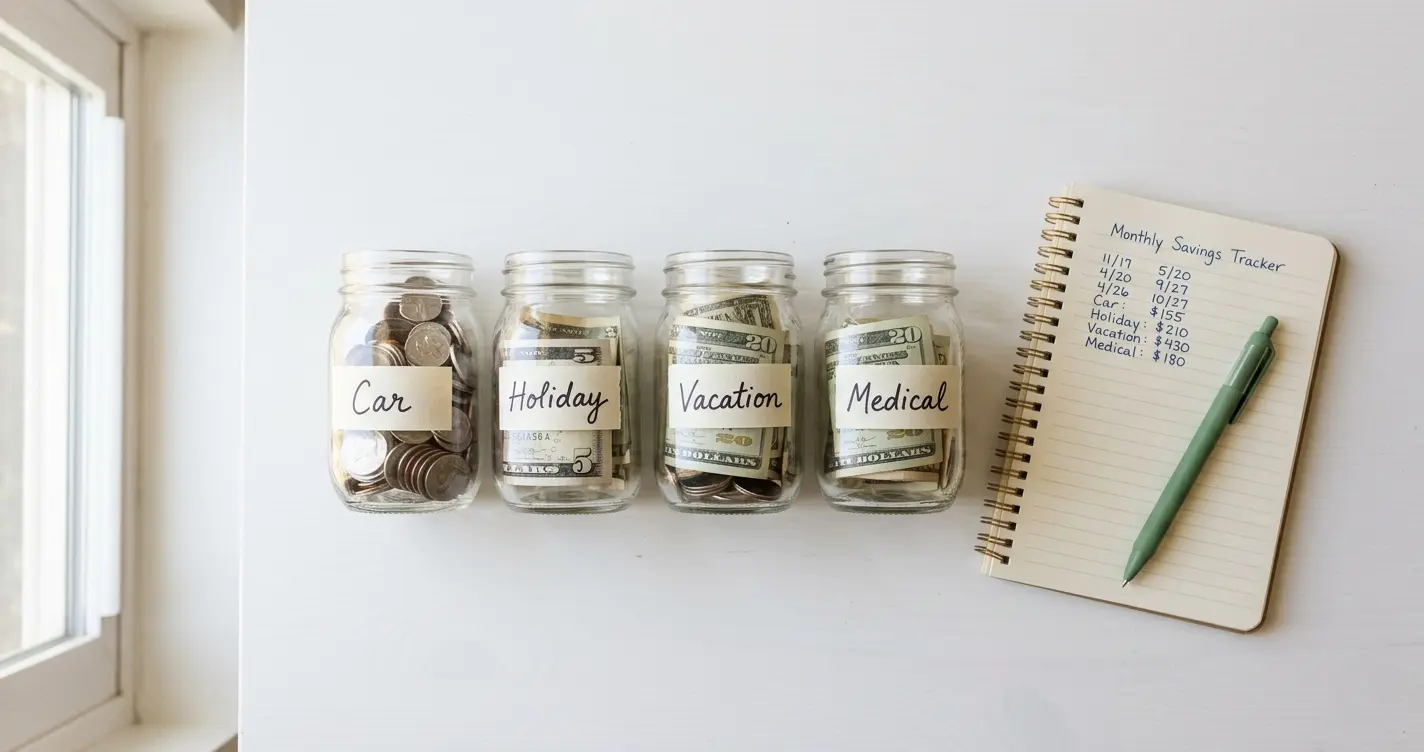
Every year, millions of budgets fall apart in December. Not because people are bad with money — but because they forgot to plan for Christmas in January.
Car registration. Annual insurance premiums. Back-to-school supplies. Holiday gifts. A friend’s destination wedding. These aren’t surprise expenses. They’re predictable, scheduled, and entirely survivable — if you plan for them. If you don’t, they blow a hole in your budget, send you to your credit card, and cost you more in the long run.
That’s exactly what a sinking fund solves. It’s one of the quietest, most effective personal finance tools available, and most people have never heard of it. If you’ve ever been blindsided by an expense you technically knew was coming, this guide is for you.
| 📌 What You’ll Learn What a sinking fund is and where the term comes from · How it differs from an emergency fund · Real-world sinking fund categories and examples · Step-by-step instructions to set one up · How many accounts you actually need · The best accounts to hold sinking funds · Common mistakes and how to avoid them. |
What Is a Sinking Fund?
A sinking fund is a dedicated savings account — or a clearly labeled portion of savings — where you set aside a fixed amount of money each month toward a specific, anticipated future expense.
The core idea is simple: instead of being caught off guard when a large, predictable expense arrives, you spread the cost over time. You save a little each month so that when the bill comes due, the money is already sitting there waiting.
Here’s the clearest way to think about it: if you know your car registration costs $240 every December, you can either scramble to find $240 in December — or save $20 per month starting in January. Both paths end at the same place. One of them is stressful; the other is not.
| 💡 A Simple Sinking Fund Example Say you’re planning a family vacation in July that will cost $2,400. If you start saving in January, you have six months to prepare: $2,400 ÷ 6 months = $400 per month. You create a sinking fund labeled “Summer Vacation,” automate $400/month into it, and by July, the trip is fully funded. No credit card debt. No stress. No compromise. |
That’s it. That’s the whole concept. But the implications for your financial life are significant.
| 📖 The Origin of the Term The phrase “sinking fund” actually originates in corporate finance and government debt management — not personal budgeting. Governments and corporations have used sinking funds for centuries to set aside money over time to repay bonds and long-term debt obligations. The concept migrated into personal finance because the underlying logic is identical: save steadily now so you can meet a known future obligation without strain. |
Sinking Fund vs. Emergency Fund: What’s the Difference?
This is the most common point of confusion for beginners — and it’s worth getting right, because the two serve completely different purposes and should be managed separately.
| 🛡️ Emergency Fund Covers unexpected, unplanned expenses — job loss, sudden medical bills, urgent repairs. You don’t know when or if these will happen. Standard guidance: 3–6 months of essential expenses. It should almost never be touched. | 📅 Sinking Fund Covers expected, planned expenses — annual insurance, holidays, car maintenance, vacation. You know these are coming. The fund exists to spread predictable costs over time. You use it regularly, by design — it empties and refills on a cycle. |
The key distinction: emergency funds handle the unknown; sinking funds handle the known. Both are essential. They are not interchangeable, and mixing the two creates a messy, poorly understood pool of money that typically gets spent without intention.
Think of your emergency fund as an insurance policy you hope never to claim — and your sinking funds as envelopes you’re steadily filling for purchases you’ve already planned.
Why Sinking Funds Are One of the Most Powerful Budgeting Tools
The personal finance community talks constantly about emergency funds, budgets, and investment accounts. Sinking funds rarely get the same attention — which is strange, because for day-to-day financial stability, they might be the most immediately useful tool of all.
1. They Turn ‘Emergencies’ Into Non-Events
A staggering number of financial “emergencies” aren’t emergencies at all — they’re predictable expenses that simply weren’t planned for. A Bankrate survey found that only 44% of Americans could cover a $1,000 unexpected expense from savings. But many of those so-called unexpected expenses — car repairs, home maintenance, medical deductibles — are entirely foreseeable categories, even if the exact timing and amount vary.
Sinking funds transform these from crises into line items. Your car will need maintenance. Your home will need repairs. If you have a $150/month car maintenance sinking fund, a $600 brake job is an inconvenience — not a catastrophe.
2. They Protect Your Emergency Fund
When people drain their emergency fund for a planned vacation or holiday shopping, they’re left exposed if a genuine emergency strikes afterward. Sinking funds keep the emergency fund intact for its actual purpose — true, unexpected crises — by handling everything else before it reaches that level.
3. They Eliminate ‘Budget Busters’
Every experienced budgeter knows the feeling: you’ve had a perfect month, your budget is on track, and then — a $400 vet bill, a $600 car service, or $500 in Christmas gifts blows everything apart. Sinking funds eliminate this pattern entirely. Those costs are already accounted for, funded in advance, and waiting when needed.
4. They Reduce Financial Stress
A 2023 study published in the journal Financial Planning Review found a direct correlation between financial preparedness — specifically having money set aside for anticipated expenses — and reduced financial anxiety. Knowing that your annual bills are covered is not a small psychological benefit. It’s a meaningful reduction in one of the most common sources of chronic stress in modern life.
5. They Keep You Out of Debt
Without sinking funds, irregular expenses go on credit cards. Credit card debt at 20–24% APR is extraordinarily expensive. A $1,200 charge that takes 12 months to pay off at 22% APR costs roughly $145 in interest — on top of the original expense. Sinking funds cost nothing. They’re just pre-planning.
| 📊 The Numbers Don’t Lie If you have five sinking fund categories averaging $150/month each ($750 total), you’re setting aside $9,000 per year for known expenses. Without sinking funds, that $9,000 either strains your monthly cash flow unpredictably, goes on credit cards, or — most commonly — just doesn’t get spent on what it should, and deferred maintenance and obligations compound. |
What Should You Have a Sinking Fund For?
The categories below represent the most common and highest-impact sinking fund uses. You don’t need all of them — but you should consider any that apply to your life.
| Category | What It Covers | Suggested Monthly Savings |
| Car Maintenance & Repairs | Oil changes, tires, brakes, unexpected repairs | $75–$200/month |
| Annual Car Registration | DMV fees, emissions testing, stickers | $20–$80/month |
| Home Repairs & Maintenance | HVAC service, plumbing, roof, appliances | $100–$300/month |
| Holiday & Gift Giving | Christmas, Eid, Diwali, birthdays, weddings | $80–$250/month |
| Vacation & Travel | Flights, hotels, activities, spending money | $100–$400/month |
| Medical & Dental Costs | Deductibles, copays, glasses, dental work | $50–$150/month |
| Pet Care | Vet visits, grooming, medication, emergencies | $50–$150/month |
| Annual Insurance Premiums | Home, auto, life — if paid annually | $50–$200/month |
| Back-to-School / Children | Supplies, clothing, activities, fees | $50–$150/month |
| Technology Replacement | Laptop, phone, or other device upgrades | $40–$120/month |
| Clothing & Wardrobe | Seasonal updates, workwear | $30–$100/month |
| Subscriptions (Annual) | Amazon Prime, antivirus, professional tools | $20–$60/month |
| Moving Costs | If a move is anticipated within 1–2 years | $100–$300/month |
| Home Purchase Down Payment | Saving toward a specific purchase target | Goal-based |
The right sinking fund categories are the ones relevant to your actual life. A renter with no car has different needs than a homeowner with two vehicles. Start with the three or four categories that cost you the most stress or surprise each year.
How to Set Up a Sinking Fund: Step by Step
Setting up a sinking fund takes about 20 minutes. Here’s the exact process:
- List every anticipated irregular expense for the next 12 months. Think through your calendar: annual fees, planned trips, medical appointments, car service milestones, holidays, expected purchases. Write them all down.
- Assign an estimated cost and a target date to each item. “Christmas gifts — $800 — December.” “Car tires — $600 — March.” “Vacation — $2,000 — August.” Rough estimates are fine at this stage.
- Calculate the monthly savings amount for each. Formula: Target amount ÷ Months until you need it = Monthly savings. If you have 8 months to save $800 for the holidays: $800 ÷ 8 = $100/month.
- Decide where to hold each fund. A high-yield savings account (HYSA) with sub-account or bucket features is ideal. More on this below.
- Open the account(s) and label each fund clearly. Naming your accounts (“Vacation 2026,” “Car Fund,” “Holiday Gifts”) is psychologically powerful — it creates a mental barrier against spending the money on something else.
- Set up automatic monthly transfers on payday. Automate the exact monthly savings amounts from your checking account. Automation is the single most important habit in personal savings.
- Review and adjust quarterly. Life changes. A car you planned to keep another three years might need replacing in one. Review your sinking fund targets every three months and update as needed.
The Monthly Savings Formula
| 🧮 Monthly Sinking Fund Contribution Total Target Amount ÷ Months Until Needed = Monthly Savings Example: $1,200 car maintenance fund ÷ 12 months = $100/month |
Where to Keep Your Sinking Funds
The account type you choose matters more than most people realize. The right account protects your sinking funds from impulse spending, earns you interest, and makes the money accessible when you actually need it.
High-Yield Savings Accounts (HYSAs) — Best Option for Most People
A high-yield savings account offers significantly higher interest rates than traditional bank savings accounts — often 4–5% APY as of early 2026, compared to the national average of 0.46% at traditional banks. On a $5,000 sinking fund balance, the difference is roughly $225 per year in interest — for doing nothing differently except choosing the right institution. Compare current rates at NerdWallet’s best high-yield savings accounts (updated regularly).
The best HYSAs for sinking funds also offer sub-account or “bucket” features, allowing you to label separate savings goals within one account:
- Ally Bank — Offers “savings buckets” within a single account. No minimum balance. Consistently high APY. Perfect for organizing multiple sinking funds.
- Marcus by Goldman Sachs — No fees, no minimums, consistently competitive APY. One of the most trusted HYSAs available.
- SoFi — High APY with additional perks for direct deposit users. Multiple savings vaults available.
- Capital One 360 — Easy to open multiple savings accounts with different labels. Ideal for the sinking fund approach.
What About Keeping It in Your Checking Account?
Some people prefer to keep all sinking fund money in their checking account and track it mentally or in a spreadsheet. This works for disciplined individuals but is risky for most — the money blends with everyday spending and tends to disappear quietly. A separate account, even at the same bank, creates crucial psychological separation.
Should You Invest Sinking Fund Money?
No — for funds you’ll need within 1–3 years, investing is inappropriate. Market volatility means your $2,000 vacation fund could become $1,600 right when you need to book flights. Short-term sinking funds belong in stable, liquid accounts. The exception: if you’re saving for a goal 3–5+ years away (like a home down payment), a conservative investment approach may be appropriate. For more on this boundary, see our guide on saving vs. investing.
| ⚠️ Important: Keep Sinking Funds Separate from Your Emergency Fund Even if you’re using the same bank, label and track sinking funds distinctly from your emergency fund. Commingling them leads to a common trap: spending “emergency money” on a holiday trip you could have saved for separately, then having no cushion when an actual emergency hits. |
Real-World Sinking Fund Examples
Let’s walk through two realistic scenarios to show exactly how sinking funds work in practice.
Example 1: Single Renter, $3,200/Month Take-Home
Sarah is 28, rents an apartment, has a car, and earns $3,200/month after tax. She’s identified four sinking fund categories:
| Sinking Fund | Annual Target | Months | Monthly Savings |
| Car Maintenance & Registration | $900 | 12 | $75 |
| Holiday Gifts & Travel Home | $1,200 | 12 | $100 |
| Vacation (Summer Trip) | $1,800 | 9 | $200 |
| Medical Deductible Buffer | $600 | 12 | $50 |
| TOTAL MONTHLY | — | — | $425 |
Sarah sets up four sub-accounts at Ally Bank, automates $425/month split across them, and earns approximately 4.5% APY on the growing balances. At the end of the year, every expected expense is fully funded — and she’s earned roughly $85 in interest doing it.
Example 2: Family of Four, $7,500/Month Take-Home
The Martinez family owns a home, has two cars, two children, and earns $7,500/month combined after tax. Their sinking funds:
| Sinking Fund | Annual Target | Months | Monthly Savings |
| Home Repairs & Maintenance | $3,600 | 12 | $300 |
| Car #1 Maintenance | $1,200 | 12 | $100 |
| Car #2 Maintenance | $1,200 | 12 | $100 |
| Holiday Gifts & Decorating | $2,400 | 12 | $200 |
| Family Vacation | $4,800 | 12 | $400 |
| Kids’ Activities & Back-to-School | $2,400 | 12 | $200 |
| Medical & Dental Deductibles | $2,400 | 12 | $200 |
| Annual Insurance Premiums | $1,800 | 12 | $150 |
| TOTAL MONTHLY | $19,800 | — | $1,650 |
$1,650/month is 22% of their income — but this is money they were already spending on these things. The difference is that it’s now planned, funded in advance, and earns interest rather than landing on a credit card.
How Many Sinking Fund Accounts Do You Actually Need?
The honest answer: as many as meaningfully help you — and not one more. Opening 14 separate savings accounts creates administrative overhead and anxiety. But grouping everything into one unlabeled pot loses the organizational benefit. A practical middle ground for most people is three to seven sinking funds, grouped thematically:
- Vehicle Fund: covers all car-related expenses — maintenance, registration, tires, unexpected repairs.
- Home Fund: for renters, covers a moving fund. For homeowners, covers repairs, maintenance, and improvements.
- Holiday & Gifts Fund: all gift-giving, holiday celebrations, and seasonal spending.
- Travel Fund: vacations, weekend trips, flights home for the holidays.
- Medical Fund: deductibles, dental work, glasses, prescriptions, and health-related costs.
- Annual Subscriptions & Fees Fund: any bill paid annually rather than monthly.
- General ‘Life’ Fund: catch-all for smaller irregular costs that don’t warrant their own category.
You can maintain these as separate sub-accounts in one bank — Ally Bank’s buckets, Capital One’s 360 accounts, or SoFi’s vaults all support this — or track them as labeled rows in a spreadsheet within a single savings account.
Best Tools to Track and Manage Sinking Funds
You don’t need complex software. But having the right tool makes the process noticeably smoother.
Banking Apps With Built-In Bucket/Vault Features
- Ally Bank — Savings Buckets: name and allocate portions of one savings account to different goals. Visual, intuitive, and free.
- Capital One 360 — Multiple Accounts: open unlimited named savings accounts at no cost.
- SoFi — Savings Vaults: separate vaults with APY tracking per goal.
Budgeting Apps
- YNAB (You Need A Budget): built around the concept of giving every dollar a job — sinking funds are a native part of its design. $14.99/month or $99/year, 34-day free trial.
- Goodbudget: digital envelope budgeting. You can create envelopes specifically for sinking fund categories. Free tier available.
Spreadsheet Templates
Google Sheets and Excel both work well. Vertex42’s free sinking fund template is particularly well-designed — it tracks multiple funds, calculates required monthly savings automatically, and shows progress visually. Bankrate’s savings goal calculator lets you input a target amount and date and tells you exactly what to save each month.
Common Sinking Fund Mistakes to Avoid
1. Not Separating Sinking Funds From Your Emergency Fund
Already covered above — but worth repeating because it’s the most damaging mistake. Mixing them turns both into a vague savings pile that usually gets spent on neither emergencies nor planned expenses effectively.
2. Setting Unrealistically High Monthly Contributions
If your budget is already tight, committing $800/month to sinking funds when you can realistically save $300 sets you up to fail. Start with the two or three highest-priority categories and build from there. If you’re still building your basic financial foundation, our guide on how to stop living paycheck to paycheck walks through how to find margin in a tight budget. Partial funding is dramatically better than perfect planning you never execute.
3. Forgetting to Replenish After You Spend
After you use a sinking fund — say, after the holidays — restart contributions immediately for next year. Many people spend the fund in December and then forget to start saving again until October, leaving themselves underfunded when December returns.
4. Not Accounting for Inflation in Long-Term Funds
If you’re saving for a home down payment or a large purchase over multiple years, the cost may increase. Review your target amounts annually and adjust for price changes, especially in volatile categories like home repair and travel.
5. Creating Too Many Funds
Having 18 sinking fund categories sounds thorough but creates decision fatigue and administrative burden. If you’re finding the system unmanageable, consolidate into broader categories. A simple system you maintain beats a perfect system you abandon.
6. Putting Sinking Funds in a Checking Account
Keeping sinking fund money in your checking account — even mentally labeled — almost always leads to it being spent on everyday expenses. The physical separation of a different account is one of the simplest and most effective behavioral tools in personal finance.
Frequently Asked Questions About Sinking Funds
Should I pay off debt before starting sinking funds?
Not entirely — it’s a balance. If you have high-interest debt (credit cards above 15% APR), that should be your first priority beyond a small emergency fund. But completely ignoring sinking funds while paying off debt means predictable expenses keep landing on credit cards, often undoing your progress. A minimal sinking fund for car maintenance and medical costs while aggressively paying down debt is a reasonable approach for most people.
What if I can only save a small amount?
Start with whatever you can. $20/month toward holiday gifts is $240 by December — meaningfully better than nothing. The habit matters more than the amount early on. You can increase contributions as your financial situation improves.
Can I use a sinking fund for a down payment on a house?
Absolutely — a home down payment is one of the most popular long-term sinking fund goals. For this specific goal, since the timeline may be 3–5 years, you may consider a high-yield savings account initially, then transitioning to a conservative brokerage account if your timeline extends. Many people also explore strategic use of Roth IRA contributions for first-time home buyers in the U.S. See IRS guidance on Roth IRA first-time home buyer withdrawals for the official rules.
How is a sinking fund different from a savings account?
A sinking fund is a purpose — a savings account (or sub-account) is where it lives. You can have a savings account without a clear purpose; a sinking fund always has a specific, named goal and a target amount. The structure and intentionality are what make sinking funds work, not the account type itself.
What if I need the money before I’ve fully funded the sinking fund?
Use what you have and adjust. If your car needs $800 in repairs and you’ve only saved $500 in your car fund, use the $500 and pay the remaining $300 from your general budget or a low-interest option. Then rebuild the fund. This is still dramatically better than having zero saved — and it’s exactly why sinking funds should be started as early as possible, even at small amounts.
How do sinking funds fit into a zero-based budget?
Perfectly — sinking funds are one of the core features of zero-based budgeting. In a zero-based budget, every dollar is assigned a purpose before the month begins. Sinking fund contributions are assigned dollar amounts just like rent and groceries — they’re treated as non-negotiable monthly expenses rather than optional savings. This is precisely what prevents them from getting squeezed out by other spending.
Can I have sinking funds if I’m still building my emergency fund?
Yes — and you should, at a minimal level. A very small car maintenance fund ($30–$50/month) and a medical fund ($25–$50/month) can coexist with emergency fund building. The reason: without any car or medical sinking fund, the first unexpected expense in those categories will either drain your emergency fund or go on a credit card. Start small and scale up as your emergency fund reaches its target.
How do I know if my sinking fund contributions are realistic?
Run a simple test: add all your planned monthly sinking fund contributions to your fixed expenses and necessary spending. If the total exceeds 90% of your take-home income, you’re over-committed. Scale back to your two or three highest-priority categories and expand once your income grows or other expenses decrease. The right amount is the one you can actually sustain month after month without stress.
The Bottom Line: Small Savings, No Surprises
Sinking funds are not glamorous. They won’t make you rich overnight. They don’t require complicated investment knowledge or financial sophistication. What they do — consistently and reliably — is eliminate the most common and predictable source of budget chaos: expenses you knew were coming but didn’t plan for.
The car registration. The Christmas gifts. The annual insurance bill. The vacation you’ve been wanting. These are not surprises. They’re certainties. Sinking funds give you a system to handle them calmly, on your own terms, without debt.
If you set up just three sinking funds this month — one for your vehicle, one for holidays, one for medical costs — and automate modest contributions to each, you will feel the difference within six months. Once the habit is in place, the next step is making sure every dollar has a clear purpose: that’s the job of a zero-based budget that treats sinking fund contributions as non-negotiable line items alongside your rent and utilities.
| 🚀 Your 3-Step Action Plan 1. List every irregular expense you know is coming in the next 12 months — car, holiday, insurance, travel, medical. Estimate a cost and a date for each. 2. Pick your top 3 categories, divide each target by months remaining, and open a labeled sub-account or savings bucket today (Ally Bank, Capital One 360, or SoFi are ideal). 3. Set up automatic transfers on payday for each fund. Then forget about it — the money will be there when you need it. |